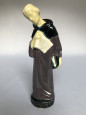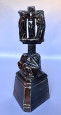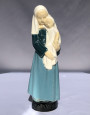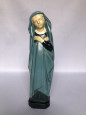
Virgin of the Annunciation

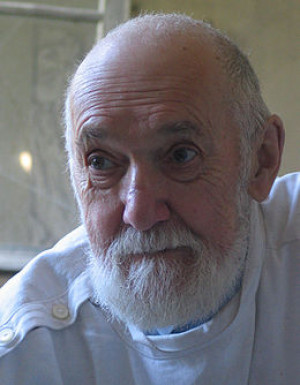
Jean Fréour was born in Nantes. From a very young age, Fréour declared his determination to become a sculptor, much to his parents’ dismay. His resolute nature eventually won them over, and in 1936 he set off for the École des Beaux-Arts in Bordeaux, where he studied under Malric. In 1939, he was awarded a scholarship to continue his studies at the École des Beaux-Arts in Paris, a testament to his talent. But this was without taking into account his strong-willed nature and his reclusive streak, which did not sit well with life in Paris or in Henri Bouchard’s studio. This was the first of his unconventional decisions. There would be others.
He returned to Issé, near Châteaubriant, to live with his grandfather and set himself up in a barn to work. In 1942, a gallery owner in Nantes organised an exhibition for him, and commissions began to come in. Jean Fréour mainly produced public commissions—often of a religious nature—for local councils, but he also worked for collectors and a few private individuals.
He joined the Seiz Breur movement in 1944; Jean Fréour belonged to the second generation of this major artistic movement. He carried on its principles by developing a body of sculptural work that combines his Breton heritage with a refined and resolutely contemporary aesthetic.
In 1952, having won the Casa Velázquez Foundation competition, he set off for Madrid, initially for two years. But once again, far from his homeland, the recluse did not feel at ease; after five months in Spain, he returned home. In 1953, whilst staying at the HB factory, a modeller working in Vallauris, impressed by his technique, told him that Picasso was looking for a sculptor to create his ceramics. Once again, he turned down the offer. Jean Fréour could only work for himself.
Then, in 1955, he settled in Batz-sur-Mer and resumed his monumental commissions: a Christ the King standing five metres eighty tall, towering over the Loroux-Bottereau vineyard; a Saint Conwoïon in pink granite, two metres sixty tall… He sculpted in every material: wood, marble, granite, onyx – nothing was beyond him.
Then, in 1966, he moved away from religious subjects to some extent, returning to his first love: the sculpture of the female nude. In his work, sensuality is present, but without any suggestive eroticism. A face is the transparent image of the soul; a beautiful body, the dwelling place of the spirit. It was also during this period that he took up painting, creating landscapes and still lifes in watercolour. In 1969, he married his muse, Soizic de Closmadeuc, who brought a new radiance to his art.
He is a proud, honest, profound and spiritual artist who shuns trends and draws inspiration for each of his works solely from within himself. He is a loner with a passion for pure beauty and a formidable temperament.