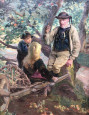
The story of Grandfather

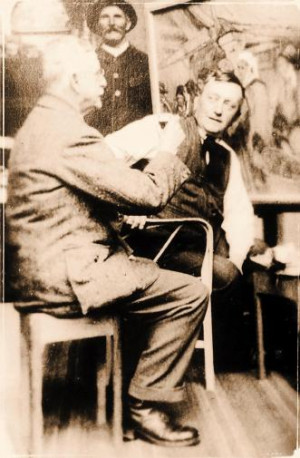
Arthur Midy is one of the leading figures of the Le Faouët school. Born in Saint-Quentin, he trained at the École des Beaux-Arts in Paris and then at the Académie Julian under Jean-Paul Laurens and Benjamin-Constant. From 1897 onwards, he exhibited at the Salon des Artistes Français, where he was awarded a silver medal in 1914.
It was in 1905 that he discovered Le Faouët and began to explore genre scenes and landscapes, moving away from the historical and biblical subjects for which he had been trained. From then on, he divided his time between Paris and Le Faouët. In 1914, it was he and David-Nillet who opened the first museum in Le Faouët, which, at the time, consisted of a single room in the town hall. In 1921, Arthur Midy was appointed as an expert to the commission for the restitution of works of art seized in France by the Germans. It was in this way that he met Émilie Maïer, who would become his second wife in 1938. Over the years, he gradually moved from academic painting to a bold and vibrant style, paying ever greater attention to the play of light and colour. He painted extensively from life, criss-crossing the countryside by bicycle. His work is of great ethnographic richness. He painted all over Finistère and Morbihan. From 1925 onwards, he exhibited regularly at the Salon des Beaux-Arts in Lorient.
Arthur Midy and his wife met a tragic end. They were killed at the end of the Second World War by the Resistance, which considered that this Franco-German couple had compromised too much.