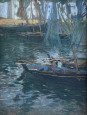
Drying blue nets in Concarneau


Born in Philadelphia, Charles Henry Fromuth was an American painter who studied at the Pennsylvania Academy of the Fine Arts under Thomas Eakins, a leading figure in American Realism. In search of new sources of inspiration, he moved to France in 1889 and discovered Concarneau in July 1890. Captivated by the light of Brittany and the bustling activity of its fishing port, he settled there permanently.
Deeply influenced by his discovery of Japanese art—particularly the work of Hokusai—at the 1900 World’s Fair, Fromuth developed a unique pictorial style, emphasizing movement, the simplification of forms, and the play of light. Pastel and charcoal became his preferred media, allowing him to capture atmospheric variations and the ballet of boats with great freedom.
Recognized during his lifetime, he exhibited at major European and American art shows and received several awards, including a gold medal in Munich in 1897 and a silver medal at the 1900 Paris World’s Fair. He also socialized with leading artists of his time, including Auguste Rodin, who visited him in Concarneau in 1901.
Beginning in 1910, he gradually withdrew from the art scene and led a quiet life, devoted entirely to his art. For nearly fifty years, Concarneau remained his home base and his primary source of inspiration. He tirelessly painted sailboats, sardine boats, and tuna boats, making the sea his almost exclusive subject.
Charles Fromuth passed away in Concarneau on May 26, 1937. His work, imbued with poetry and sensitivity, reflects a deep fascination with the sea and a constant quest for movement and light.

