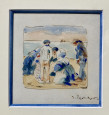
Pardon at the Trémalo chapel in Pont-Aven

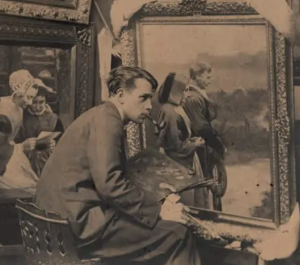
Jean-Bertrand Pégot-Ogier, born on May 7, 1877, in Salamanca, Spain, was a French painter, engraver, illustrator, photographer, and writer whose career was deeply rooted in the Breton artistic landscape of the Belle Époque.
Born into a cultured family, he grew up in Hennebont, where his father, a writer, photographer, and art lover, created an artistic atmosphere that stimulated his curiosity from an early age. Pégot-Ogier studied at the Lycée de Lorient and turned to painting at the dawn of the 20th century.
While on vacation in Concarneau, he met Théophile Deyrolle and Alfred Guillou, major figures of the Concarneau School, who influenced his early pictorial explorations and awakened in him a sensitivity to the Breton landscape and culture.
He exhibited for the first time in Paris at the Salon des Artistes Français in 1900 and 1901, showing scenes inspired by Breton life. Gradually, he moved away from stereotypical picturesque themes and developed a more personal artistic language, oscillating between Impressionism and Synthetism, where brushstrokes, light, and color became instruments for expressing a deeper connection to Brittany and its traditions.
His work, entirely devoted to Breton themes—scenes of pardons, landscapes, figures from everyday life—shows a dual influence: on the one hand, the realist teaching of Concarneau, and on the other, the more modern aesthetic of the Pont-Aven School and painters such as Henry Moret, who tempered his style and enriched his use of color.
Mobilized at the start of the First World War, Pégot-Ogier died at the front on October 2, 1915, in Moulin-sous-Touvent (Oise).